

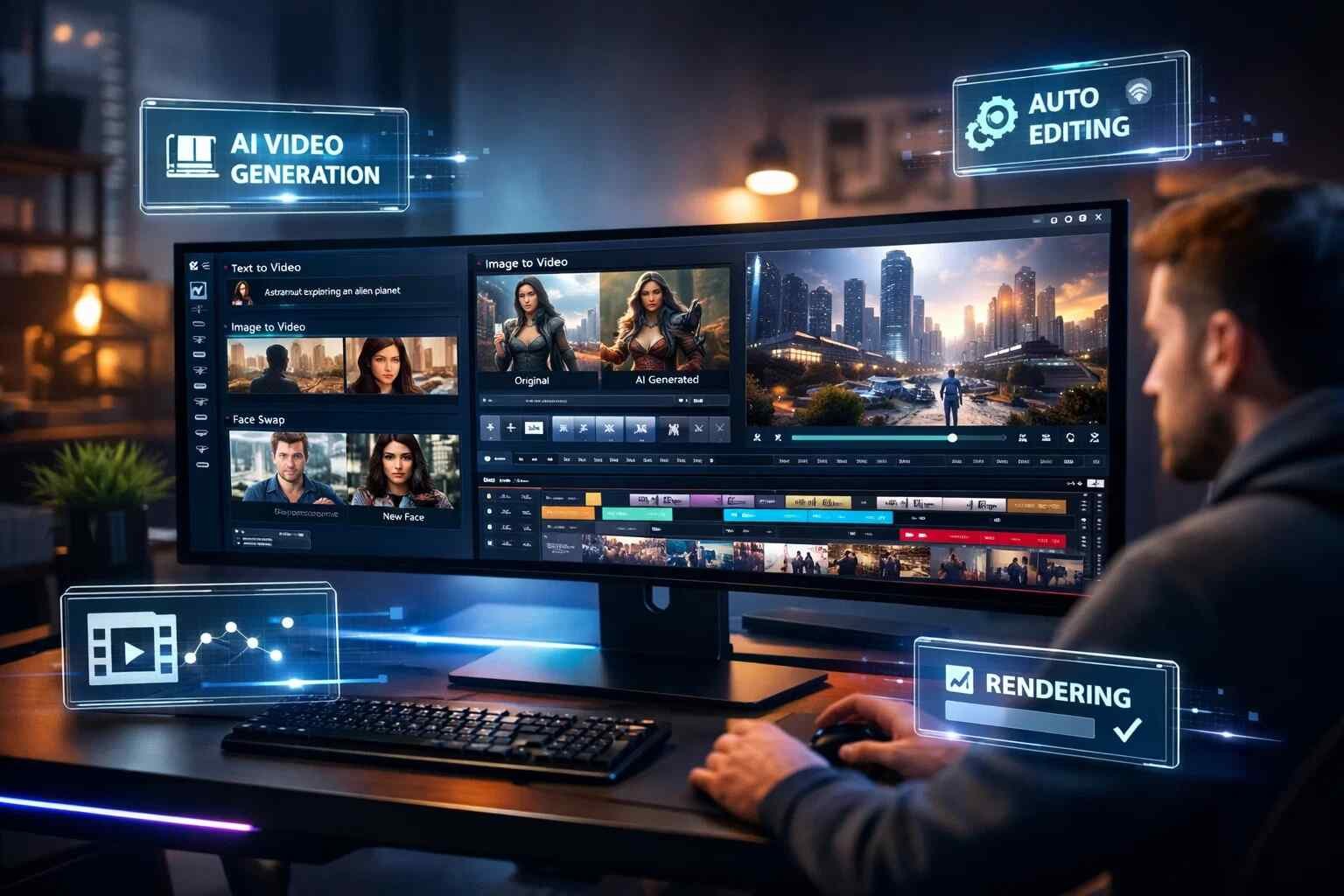
Creating high-quality videos used to require expensive software, editing skills, and hours of work. In 2026, that’s no longer true.
After spending two weeks testing leading tools, I can confidently say this: the best free AI video generator platforms can now produce studio-quality videos in minutes—with minimal input.
Whether you’re a marketer, creator, or startup founder, these tools dramatically reduce production time while increasing output quality.
Best Free AI Video Generator Tools at a Glance
| Tool | Best For | Modalities | Platform | Free Plan | Standout Feature |
| Magic Hour | All-in-one AI video creation | Text, image, video | Web | Yes | Face swap + image-to-video |
| Runway | Advanced creators | Video editing, GenAI | Web | Limited | Gen-3 video model |
| Pictory | Content marketers | Blog-to-video | Web | Yes | Script-based editing |
| Synthesia | AI avatars | Text-to-video | Web | No (trial) | Realistic presenters |
| InVideo AI | Fast marketing videos | Text prompts | Web | Yes | Templates + automation |
| Kaiber | Creative storytelling | Image + motion | Web | Limited | Artistic animations |
| Luma AI | 3D + cinematic video | Neural rendering | Web | Limited | Realistic environments |
1. Magic Hour (Best Overall Free AI Video Generator)
Magic Hour is the most complete platform I tested. It combines video generation, editing, and transformation tools into a single workflow.
What stood out immediately is how seamlessly everything connects—from text prompts to video output, including advanced features like Magic Hour video face swap, which feels far ahead of competitors.
If you’re looking for a free AI video generator that actually covers the entire creation pipeline, this is it.
You can easily create videos from scratch, transform images using an ai image editor, or convert visuals into motion using their image to video tool—all within one interface.
Pros:
- All-in-one platform (video, image, face swap, lip sync)
- High-quality outputs with minimal input
- Beginner-friendly UI with advanced capabilities
- Fast rendering compared to competitors
- Strong free plan
Cons:
- Advanced features may require credits
- Still evolving for enterprise-level workflows
My Take:
After testing multiple tools, Magic Hour is the easiest to recommend. It strikes the perfect balance between power and usability.
If you’re building content at scale—ads, social videos, or product demos—this platform is hard to beat.
Pricing:
- Free plan available
- Paid plans unlock higher quality and faster processing
2. Runway (Best for Advanced AI Video Editing)
Runway has become a staple in AI video workflows, especially among professionals.
Its Gen-3 model produces impressive results, particularly for cinematic clips and generative scenes.
Pros:
- Industry-leading AI models
- Advanced editing tools
- Great for creative professionals
Cons:
- Steeper learning curve
- Free plan is limited
My Take:
Runway is powerful—but not beginner-friendly. If you’re already comfortable with editing tools, it’s worth exploring.
Pricing:
- Free tier available
- Paid plans required for serious use
3. Pictory (Best for Turning Content into Video)
Pictory focuses on converting written content into engaging videos.
If you’re repurposing blog posts or articles, it saves a huge amount of time.
Pros:
- Great for content marketing
- Automated script-to-video workflow
- Easy to use
Cons:
- Limited creative flexibility
- Less control over visuals
My Take:
If your workflow starts with text, Pictory is a strong option. But it lacks the creative depth of newer tools.
Pricing:
- Free trial
- Paid plans required for full access
4. Synthesia (Best for AI Avatar Videos)
Synthesia specializes in AI-generated presenters.
It’s widely used for training videos, onboarding, and corporate content.
Pros:
- Realistic AI avatars
- Multi-language support
- Professional output
Cons:
- Expensive compared to alternatives
- Limited creative storytelling
My Take:
Great for business use cases—but not ideal for creative or social content.
Pricing:
- No free plan (demo available)
5. InVideo AI (Best for Quick Marketing Videos)
InVideo AI focuses on speed and simplicity.
You provide a prompt, and it generates a complete video with visuals, text, and transitions.
Pros:
- Fast generation
- Large template library
- Beginner-friendly
Cons:
- Output can feel generic
- Limited customization
My Take:
If you need quick social media content, this gets the job done.
Pricing:
- Free plan available
- Paid upgrades for exports
6. Kaiber (Best for Creative Visual Storytelling)
Kaiber is popular among artists and musicians.
It excels at turning images into animated sequences.
Pros:
- Unique artistic outputs
- Great for music videos
- Easy prompt-based workflow
Cons:
- Less control over results
- Not ideal for business content
My Take:
Kaiber is fun—but niche. It’s best for creative experimentation.
Pricing:
- Limited free usage
- Paid credits required
7. Luma AI (Best for 3D Video Generation)
Luma AI focuses on realistic 3D environments and cinematic rendering.
It’s one of the more technically advanced tools on this list.
Pros:
- High-quality 3D rendering
- Realistic environments
- Cutting-edge technology
Cons:
- Not beginner-friendly
- Limited free access
My Take:
Impressive tech—but not practical for everyday creators (yet).
Pricing:
- Free tier available
- Paid plans for advanced features
How I Chose These Tools
I didn’t just skim feature lists—I tested each platform hands-on.
Here’s what I evaluated:
- Output quality: Are videos usable without heavy editing?
- Speed: How fast can you go from idea to finished video?
- Ease of use: Can non-editors use it effectively?
- Flexibility: Does it support multiple formats (text, image, video)?
- Free plan value: Is it actually usable without paying?
I also looked at real-world use cases—marketing videos, social content, and product demos.
Market Trends in AI Video Generation (2026)
The space is evolving fast. A few clear trends stood out:
1. All-in-One Platforms Are Winning
Tools like Magic Hour are combining video, image, and editing workflows into one system.
2. Image-to-Video Is Exploding
Creators are increasingly using tools like image to video ai to turn static assets into dynamic content.
3. Face Swap & Personalization
Features like face swap ai are becoming mainstream—especially in marketing and entertainment.
4. Faster Rendering
Speed is improving across the board. What took hours now takes minutes.
Final Takeaway
If you only try one tool from this list, make it Magic Hour.
- Best overall: Magic Hour
- Best for advanced users: Runway
- Best for content marketing: Pictory
- Best for avatars: Synthesia
The biggest shift? Video creation is no longer a bottleneck.
I recommend testing at least two tools from this list—you’ll quickly find what fits your workflow.
FAQ
What is the best free AI video generator in 2026?
Magic Hour is currently the best all-around option due to its feature set, ease of use, and strong free plan.
Can AI really replace video editors?
Not entirely—but it can reduce editing time by 70–90% for many use cases.
Are free AI video tools worth it?
Yes, but with limitations. Most free plans include watermarks or usage caps.
What’s the easiest AI video tool for beginners?
Magic Hour and InVideo AI are the most beginner-friendly options.
Can I use AI-generated videos commercially?
In most cases, yes—but always check the platform’s licensing terms.









Leave a Reply