

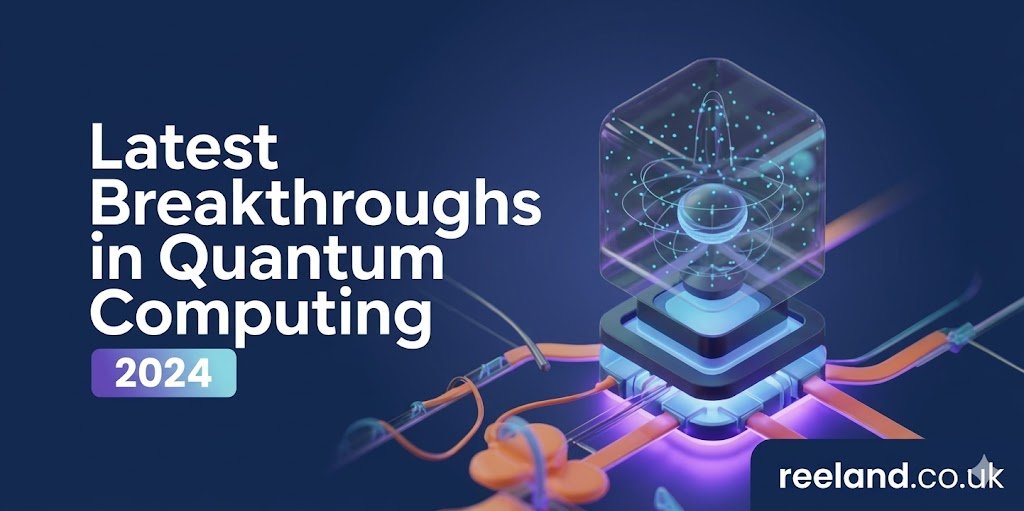
Introduction: Understanding Quantum Computing
Quantum computing is revolutionizing the way we process information by leveraging the principles of quantum mechanics. Unlike classical computers, which rely on bits represented as 0 or 1, quantum computers use qubits that can exist in multiple states simultaneously through superposition. These qubits can also become entangled, allowing for the creation of correlations that enable computations far beyond the capabilities of traditional systems. The latest breakthroughs in quantum computing 2024 have focused on improving qubit coherence, reducing error rates, and increasing processor capacity, bringing practical applications closer to reality. Researchers and companies around the world are exploring how quantum computing can transform industries such as pharmaceuticals, finance, logistics, cryptography, and artificial intelligence.
Hardware Advancements Driving Quantum Computing Forward
The field of quantum computing has seen significant hardware progress in 2024. Google introduced its Willow processor, which contains 105 superconducting qubits and has demonstrated improved error reduction as more qubits are added. This processor was able to perform complex tasks such as quantum circuit sampling significantly faster than classical supercomputers, representing a major milestone in quantum computing advances. IBM has also expanded its hardware capabilities with processors like Heron and Condor, which offer larger qubit counts and enhanced error correction. These machines, accessible through IBM’s cloud platform, allow researchers and developers to explore quantum computing applications across different scientific and industrial domains. Microsoft continues to innovate through Azure Quantum, which integrates topological qubits and trapped-ion systems from partners like IonQ, enabling hybrid classical-quantum computations. NVIDIA is exploring quantum simulations for AI, combining quantum computing and AI to enhance machine learning and data optimization. Together, these companies are defining the cutting edge of quantum computers and accelerating the path to practical, large-scale systems.
Software and Algorithmic Innovations
In 2024, software development and quantum algorithms have been just as crucial as hardware progress. Error correction has improved dramatically, allowing logical qubits to maintain coherence longer, which is essential for scaling complex computations. Hybrid quantum algorithms, which combine classical and quantum approaches, are now capable of optimizing real-world problems in finance, logistics, and artificial intelligence. Quantum machine learning frameworks are being integrated into platforms like IBM Qiskit and Google Cirq, allowing developers to test algorithms for optimization, pattern recognition, and simulation tasks. These software advancements are enabling quantum computing applications to expand beyond theoretical research into practical problem-solving across multiple sectors.
Applications of Quantum Computing
The latest breakthroughs in quantum computing 2024 are making it increasingly clear that quantum computers have practical applications. In pharmaceuticals, quantum simulations allow researchers to model molecular interactions at unprecedented accuracy, accelerating drug discovery and reducing development costs. In cryptography, the power of quantum systems poses challenges to classical encryption, prompting the development of quantum-resistant cryptographic standards. Optimization problems, such as supply chain management, resource allocation, and energy distribution, are also being addressed with quantum algorithms, enabling solutions previously unattainable with classical systems. Artificial intelligence benefits from the combination of quantum computing and classical computing, enhancing model training speed and enabling complex simulations that improve predictive analytics and autonomous systems. Additionally, scientific research, including material science and geophysics, is leveraging quantum simulations to understand molecular structures and natural phenomena at unprecedented scales.
Industry Leaders in Quantum Computing
Major technology companies have been at the forefront of the latest breakthroughs in quantum computing 2024. Google continues to push the limits with its Willow chip, demonstrating quantum supremacy on selected tasks and developing algorithms such as Quantum Echoes for practical simulations. IBM combines hardware and cloud solutions to deliver accessible quantum platforms and enable large-scale experimentation. Microsoft integrates topological and trapped-ion qubits through Azure Quantum, providing cloud access and hybrid computation capabilities. Startups like IonQ, Rigetti Computing, D-Wave, and Quantum Computing Inc. are also pushing boundaries with innovative qubit architectures, quantum annealing, and enterprise-focused quantum software. These companies, along with emerging international players, continue to expand global quantum computing infrastructure, research capacity, and applications.
Investing in latest breakthroughs in quantum computing 2024
Quantum computing is also attracting significant investment attention. Publicly traded companies, including IonQ, Rigetti, D-Wave, and Quantum Computing Inc., allow investors to access the growth potential of the sector. Major tech companies such as IBM, Microsoft, and Google provide indirect exposure through their quantum computing divisions. Quantum computing ETFs, like the Defiance Quantum ETF (QTUM), offer diversified investment across multiple companies involved in quantum technologies. While these stocks and ETFs are highly volatile, they reflect the transformative potential of quantum computing companies and the expanding commercial relevance of quantum computing stocks.
Challenges Facing latest breakthroughs in quantum computing 2024
Despite remarkable progress, quantum computing still faces significant challenges. Qubits remain highly sensitive to environmental interference, leading to errors and short coherence times. Scaling quantum systems to thousands of qubits while maintaining stability is a major technical hurdle. The cost and infrastructure requirements, including cryogenic cooling and precision fabrication, make the deployment of large-scale quantum computers complex. Software development for quantum architectures is also challenging, requiring new algorithms and programming paradigms distinct from classical systems. Overcoming these limitations is critical for the widespread adoption of quantum computers and for realizing the full potential of quantum computing advances.
Future Outlook for latest breakthroughs in quantum computing 2024
Looking ahead, the trajectory of quantum computing suggests that fully fault-tolerant quantum computers could emerge within the next decade. By the early 2030s, these systems may deliver transformative solutions across pharmaceuticals, AI, cryptography, logistics, and material sciences. The integration of quantum computing and AI will enable accelerated simulations, optimization, and predictive analytics, while global investments in research, startups, and government initiatives continue to expand. The combination of hardware innovation, algorithmic breakthroughs, and cloud accessibility ensures that the impact of quantum computing will grow significantly in the coming years.
Conclusion
The @latest breakthroughs in quantum computing 2024 represent a pivotal moment in the evolution of technology. Advances in hardware, software, algorithms, and international collaboration are moving quantum computing from theoretical exploration to real-world application. Companies like Google, IBM, Microsoft, IonQ, and Rigetti Computing are at the forefront, enabling new possibilities in pharmaceuticals, AI, optimization, cryptography, and scientific research. For investors, technology enthusiasts, and researchers, understanding quantum computing basics, industry developments, and practical applications is crucial to appreciating the transformative potential of this rapidly evolving field. Quantum computing is not just a futuristic concept—it is poised to redefine computation, innovation, and industry in the 21st century.













Leave a Reply